On the night of September 25th, 2025, mass youth protests began in Antananarivo, the capital of Madagascar. The protests were fueled by anger at frequent power cuts in the capital, but quickly turned into a wider social movement against the ruling elite.[1] One man in particular got much of the blame, that being president Andry Rajoelina, dual French-Malagasy citizen and Madagascar’s richest person.[2]
Andry Rajoelina had come to power with the help of the military unit CAPSAT in 2009, and on October 12th they again played the role of kingmaker by supporting the protestors against the presidency, dooming the Rajoelina regime.[3] Rajoelina, perhaps realizing the battle for power was lost and certainly fearing for his life, fled Madagascar on a French military plane.[4] The Malagasy protests achieved their goal of removing the president and a new government from the old opposition has been formed, though it is led by the military.[5]

Andry Rajoelina (left) and Emmanuel Macron (right). The controversy surrounding Rajoelina’s French citizenship was a central reason for his ousting from power.
The coupvolution in Madagascar has been named as part of the global phenomenon of “Gen Z protests”, an ongoing trend of youth movements opposing corruption and wealth inequality in the developing world. As interesting as the Gen z protests are, what I will be covering in this article is Madagascar’s part in another trend, that being a challenge to the still powerful French political influence in Africa.
The end result of the coup in Madagascar remains to be seen, but the old president being saved by France and the new president approaching Russia diplomatically is a sign that the French-Malagasy relationship will be cooler in the coming years than it was under Rajoelina.
This is the third main article on the Françafrique, covering the last piece of French economic, military and political influence in Africa, that being politics. A country’s political influence is in its nature harder to define than military or economic influence, as those can be measured with soldiers, arms sales, investments and trade flows. One attempt at defining political power, Brand Finance’s global soft power index, places France as the sixth most influential country in the world.[6]
Economic and military influence is also inherently political, but those channels of influence are covered in the two previous articles on the Françafrique. The more immaterial French political influence in Africa is maintained via two channels. One is the inherent influence to the continued use of the French language, and the French leadership of the Francophonie. The other channel is the personal relations maintained between France and elites in former colonies.
Language as politics, and French as a global language
The French language is the world’s sixth most commonly spoken language with over 300 million total speakers, of which only around a quarter speak it as a first language. French is also one of six official languages of the United Nations, and France is one of five permanent members of the security council.[7] The global community of French-speaking countries is organized in the Francophonie, a forum for French language education, political cooperation and media communication.
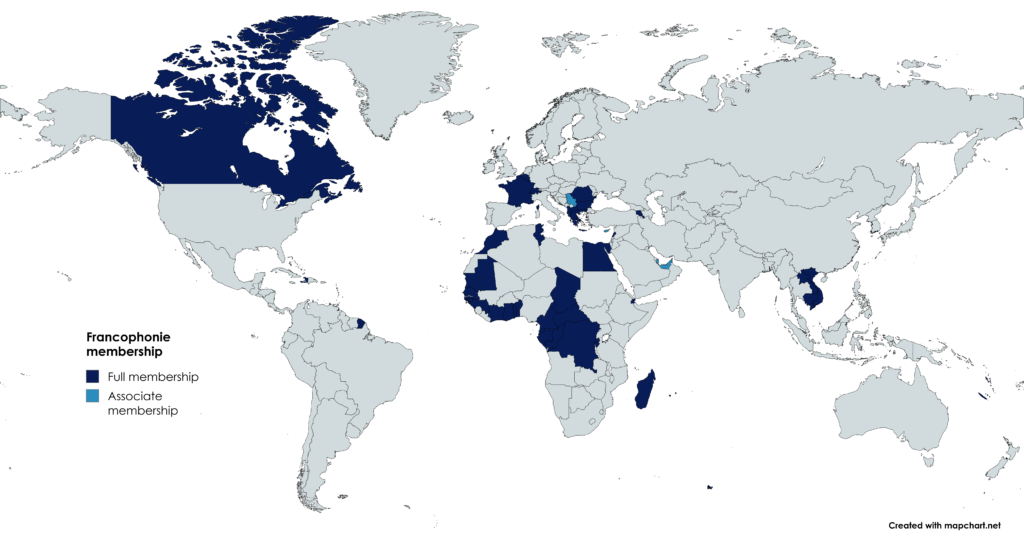
A map of global membership in the Francophonie. The membership of Balkan countries, Armenia and Egypt are particularly puzzling.
The Francophonie is a fundamentally weird organization. While it’s supposed to be based around the language, it also contains countries that don’t speak French, but were French colonies, and countries that have no real connection to France apart from good modern relations. This fact makes the Francophonie just as much of a French friendship club and colonial legacy organization as it is a language community.
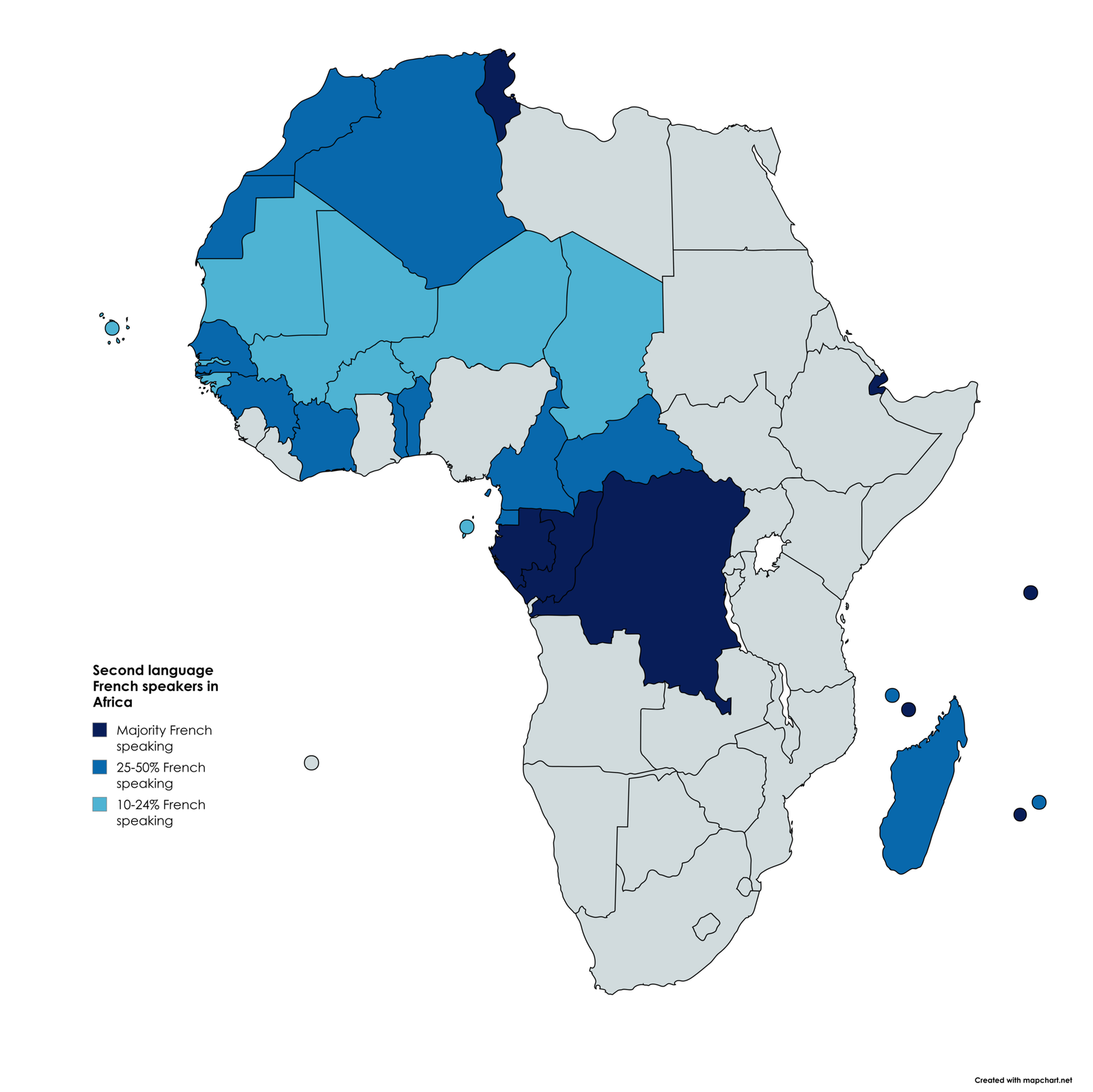
In Africa, French functions as a common language in multiple countries that have no clear linguistic majority. Eight countries in Africa have French as their sole official language, and all countries that were part of the French colonial empire have French in use as either an official or administrative language. French is known as a second language by a substantial part of the population in many countries, particularly in Central Africa and on the West African coast. Among the elites of these countries and in some capital cities, the use of French is universal.

A French road sign in Gabon telling you that you are crossing the equator.
The French use in former French colonies furthering French influence is not some happy accident for France. The francization, or process of making other lands and peoples more French, was a conscious policy carried out by the French government during the colonial era. This policy stands in contrast to the British in Africa, who developed local native rule to lessen the burden on their colonial authorities. Francization was more successful in settled coastal regions, where French control was the most complete for the longest amount of time.[8]

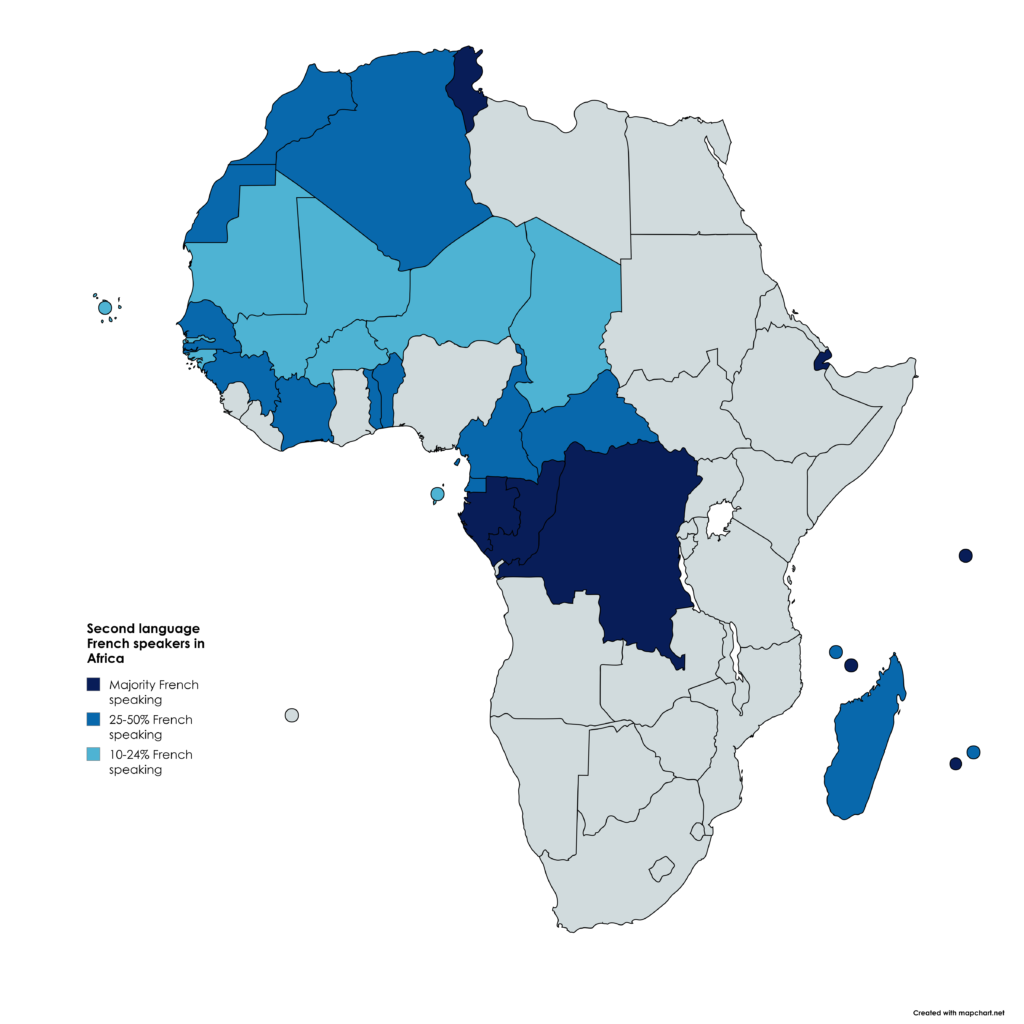
A comparison of French and Belgian colonial empires (left) and French language use in Africa (right)
This use of French makes maintaining relations practically easier. It means that soldiers, diplomats, businessmen and researchers from France have an easy access to parts of Africa where people filling the same roles from the English-speaking world would need interpreters. It means that when the French president meets the head of state of a former colony, they can both speak a language they’re comfortable with, and it means that many future African leaders seek a higher education in France, as it’s easiest.
The ease of cooperation also extends to relations between francophone African states. The Central African community ECCAS is one of the most well-integrated regional blocs of the African Union, and it’s made up primarily of French-speaking states. Similarly, the West African ECOWAS was a well-integrated regional bloc until the withdrawal of Niger, Mali and Burkina Faso. The organization still exists in its coastal member states, but it is more dominated internally by anglophone Nigeria than ever.
Francophile leadership
French political reach is helped by the leadership of a number of Francophile presidents in Africa, that being leaders who have some connection to France and support French policies in Africa. They tend to be educated in France or the United States, some owe their regime’s existence to France, and they are often old, some old enough to have been born in the French colonial empire.

93 year old Paul Biya has been president of Cameroon since 1982, and promised in his reelection bid last year that “the best is yet to come”. He has maintained a positive relationship with France throughout his reign.
The sitting presidents of the Republic of the Congo and of the Ivory Coast both gained power with French military aid, the president of Benin may have lost power in December 2025 if not for French intelligence support, and the army of Cameroon is waging a civil war in its western Ambazonia region with French weapons. Among every single one of France’s former colonies in Africa, France is among the largest trading partners, arms exporters, and sources of foreign aid.
France usually makes a point of condemning coups in their former colonies, but there is otherwise little care for democracy. Most Francophile regimes are run by family dynasties with deep ties to France, where elections are held and the result is known in advance. Military coups upset the balance and leave the status of French influence in a country uncertain, as seen in the Sahel.
The waning French sphere of influence
About a dozen countries in Africa have France as their most important foreign partner. France is in competition with the USA and China as the primary foreign power present in Africa. What’s interesting is how much weaker this position is than it was only a few years ago.
Niger, Mali and Burkina Faso are the three states leaving the French orbit that have received the most attention. The three of them have perhaps been the most vocal in breaking with France, and as of this year they are the only three countries to have ever left the Francophonie, instead forming their own Alliance of Sahel States.

Captain Ibrahim Traore, the young president of Burkina Faso, has become something of a celebrity the world over for his fiery anti-French and pan-African rhetoric.
Aside from the Alliance of Sahel States, Guinea has also broken off their alliance with France following a coup, and in Senegal and the Central African Republic no coup was needed. This decline in relative French power in Africa is what prompted the beginning of the Françafrique series. Should France cease being one of the primary non-African powers present in Africa, this would signal a monumental shift in the politics of the Central and West African regions.
The key question in how to interpret the ongoing shift is whether the change is permanent, and whether Francophile regimes will keep losing power. If the Sahel belt remains outside of the French sphere in the long term, the French ability to consolidate power in West Africa and their ability to gain resources from West Africa are both weakened. If the remaining Francophile coast states leave the French sphere of influence, France will arguably no longer be a global power.
Predicting the future
There are periods in the past where French influence in Africa has been weakened. The cold war saw multiple former French colonies turn to the Soviets for international support, and in the 90s the French-aligned regimes in Rwanda and the Congo collapsed. French neocolonial relations have not been defined by a gradual and inevitable decline, rather the 2010s were a peak of French influence in Africa since decolonization, especially in West Africa.
Most African states that have at some point broken away from the French sphere have gradually improved relations with France again through the years. Prior to the Sahel states leaving in the 2020s, every former French and Belgian colony in Africa were members of the Francophonie, aside from Algeria. No loss of French influence has been truly permanent since decolonization, yet.
What’s new and notable with the Sahel states of Niger, Mali and Burkina Faso in particular is that their governments now openly condemn France and blame French neo-colonial policies for the continued poverty and struggles of their countries. If they achieve economic growth and regime survival while decoupled from French aid, it will “prove” that their anti-French ideology is victorious. If, on the other hand, army defeats against Al-Qaida continue and the promised post-French economic boom doesn’t happen, that may be enough to demonstrate a continued reliance on France in West Africa.
In any case, the end of the Françafrique is not a foregone conclusion. The French military has disappeared from most of the countries they were present in, but economic and political influence remains in most former colonies. West and Central African regional politics will in all likelihood continue to be affected by decisions made in Paris for decades to come.
Sources
[1] https://apnews.com/article/madagascar-protests-curfew-electricity-water-0225f744e674220649fc5a0520cdfcfd
[2] https://www.cnbcafrica.com/2025/who-is-madagascars-president-andry-rajoelina
https://fineducke.com/articles/1059/richest-people-in-madagascar
[3] https://www.dw.com/en/madagascar-why-is-the-capsat-army-unit-so-influential/a-74334916
[4] https://www.france24.com/en/africa/20251013-madagascar-president-andry-rajoelina-leaves-country-weeks-of-protest
[5] https://www.reuters.com/world/africa/madagascars-military-led-government-names-mostly-civilian-cabinet-2025-10-28/
[6] https://brandfinance.com/insights/global-soft-power-index-2025-the-shifting-balance-of-global-soft-power
[7] https://www.un.org/en/our-work/official-languages
[8] https://dergipark.org.tr/en/pub/akaf/issue/81970/1393086
Leave a Reply