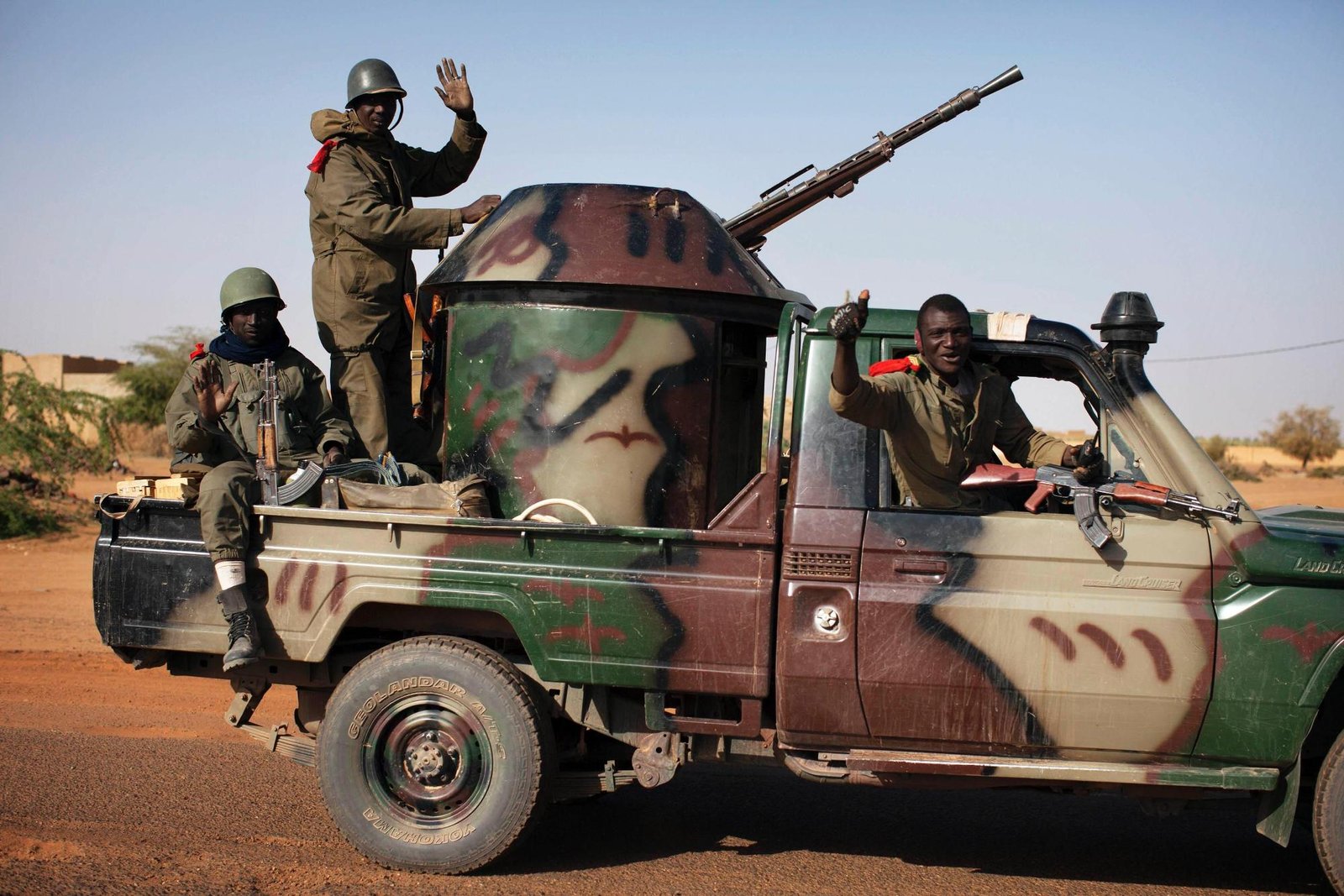
When discussing foreign policy in Africa, the war in the Sahel often serves as a backdrop, an explanation for French and other international military involvement. The war in Mali has been ongoing since 2012, and there has been no clear moment or defining event that has made it newsworthy since, apart from some media interest around Niger’s coup in 2023 and the following diplomatic crisis.
This article will focus most on Mali, which is where the war started and spread from, with a secondary focus on the war in Niger and Burkina Faso. The three of them, as well as Chad and Mauritania, make up the political region known as the Sahel.
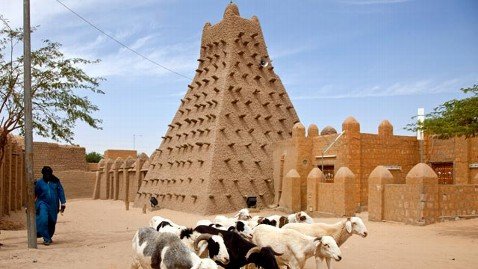
A peaceful scene in Timbuktu, where a shepherd herds his goats in front of the Sankore Madrasa.
According to ACLED’s conflict mapping, the war in the Sahel was the third deadliest war in the world in 2024 and is looking to keep that spot this year, only behind the wars in Gaza and Ukraine, and slightly more severe than the wars in Sudan and Myanmar.[1] In addition to the current death counts, the potential spread of the war makes it an event of global significance.The Sahel is the only region of the world where Al-Qaida and the Islamic State are still on a clear rise. The jihadist groups both have the initiative in the Sahel countries and are spreading into the entire west African region.
The war in the Sahel manifests itself as a massive crisis as far as the population is concerned. The already fragile agriculture sector is harmed, and food aid is too small in quantity and has troubles reaching large regions impacted by the fighting. In addition to the food situation, the war is pushing children out of school on a large scale, as the jihadist insurgents see a western-style education as an enemy of their radical interpretation of the Quran.[2]
Sources:
The Sahel as Arena
The region affected by war in West Africa is geographically enormous. Mali is about twice the size of France, and the distance from Mali’s capital of Bamako to Northern Mali’s biggest city Gao is longer than the distance from Paris to Berlin. Considering this size, the fact that the government forces in Mali only control about half the country is notable. Niger is about the same size as Mali, while Burkina Faso, the smallest of the three, only measures half a France.
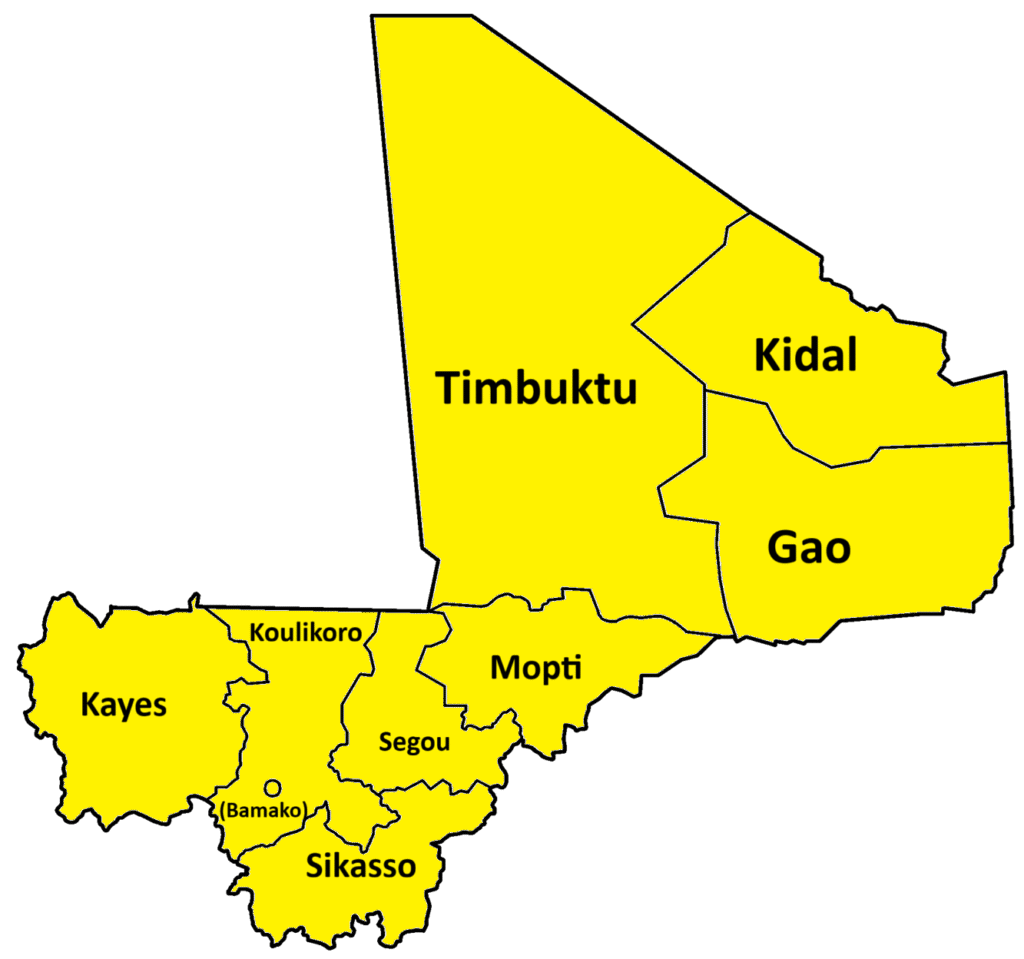
Map of the Malian regions. Every region is named after its regional capital. Timbuktu, Kidal and Gao together make up north Mali.
Niger, Mali and Burkina Faso stretch into three different climate zones. In the middle, covering the south of Niger and Mali and most of Burkina Faso, is the geographic Sahel, which the political region is named after. The Sahel is a semi-arid steppe region that supports both pastoral nomadic and settled agricultural lifestyles, and is where most of the population of all three countries resides. Burkina Faso is covered by savanna in its south, and this more favorable climate allows it to be the most densely populated of the three countries.
Niger and Mali stretch into the Sahara in the north, meaning the population density of both countries is very uneven. The Malian and Nigerien Saharan regions are thinly populated by nomadic pastoral people groups, and the Malian and Nigerien deserts are where both countries’ armies and governments have traditionally struggled most with maintaining control. These Saharan regions are also neglected in terms of infrastructure, with few and ill-maintained roads.
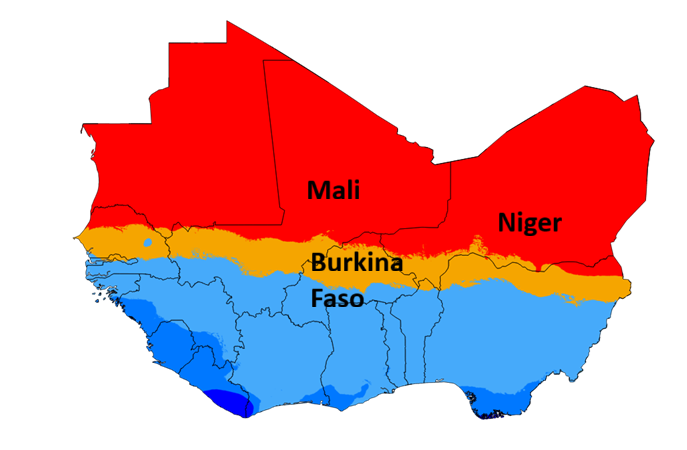
Climate zones of West Africa. Red is the Sahara, orange is the Sahel, and light blue is the savannah region known as the Sudan.
In the densely populated south, warfare is mostly positional, with roads allowing for the movement of large armed formations and cities serving as both strongpoints and strategic objectives. In the Saharan north, cities are few and far between, and supply lines for armed formations will quickly become long and vulnerable. Warfare in such an environment removes most advantages from a materially and numerically superior force, and the scale of the territory allows the smaller force to easily slip away and fight another day.
In the wars in all three countries, ethnic identity is an important factor in deciding which army a soldier fights for. Each separatist militia, jihadist movement and government force has a main ethnic group that it primarily recruits from. The Tuaregs in northern Mali and Niger have a long history of opposition to their respective governments, and present a continual strategic problem for both countries.
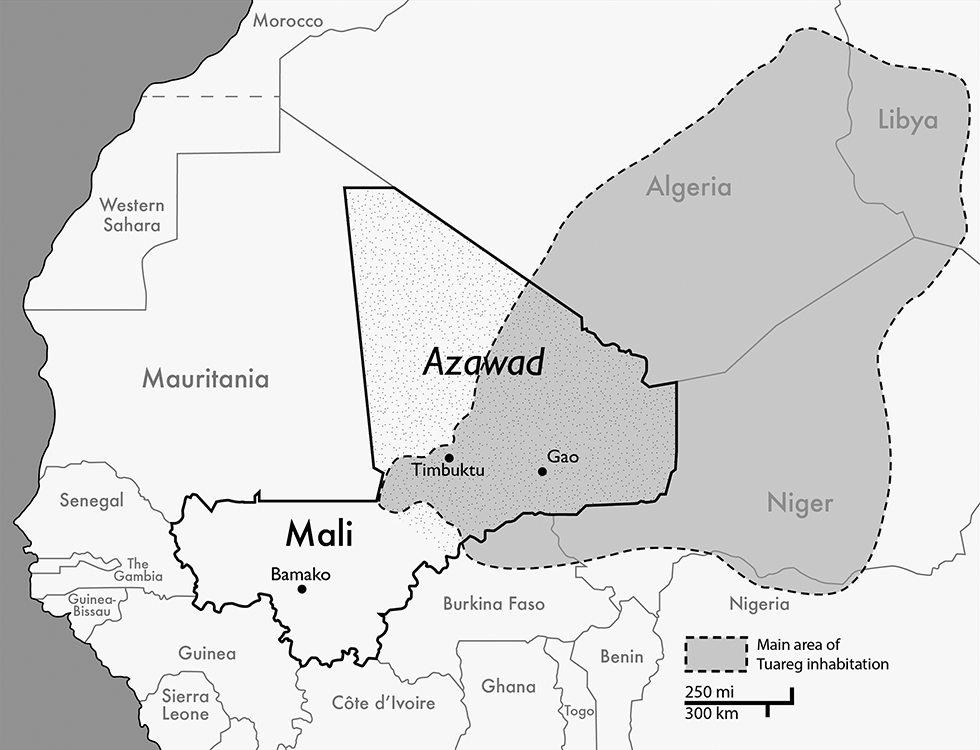
A very approximate map of Tuareg settlement.
This is not to say that none of the minorities of the countries support their governments. General and President Goïta of Mali is from the minority Senufo people, and the Malian government is allied with Plateforme, a coalition of government-friendly ethnic minority militias. The main recruitment bases for the Plateforme are loyalist Tuaregs and the Songhai people, a settled agrarian people who live in the region claimed by Tuareg separatists.
The largest ethnic group of Mali and the main group represented in the Malian army and government is the Bambara people, who make up around a third of the population. In Niger, the largest and leading group is the Hausa people, who make up around half of the population, and the Mossi people of Burkina Faso similarly make up around half. Altogether, the population of Mali, Niger and Burkina Faso is around 80 million people, split almost evenly between the three.
The Tuareg Revolt, 2012
The war in Mali began with a dual spillover from wars to the country’s north. In 2011, Tuareg fighters returned to Mali from Libya, where many of them had fought for Ghaddafi’s dying regime as mercenaries.[1] These fighters, together with Tuareg veterans from an earlier revolt in 2007-2009, form the National Movement for the Liberation of Azawad (MNLA), with the goal of complete political independence from Mali.[2] The Tuaregs are the largest exclusively Saharan people, but they do not have a state of their own.
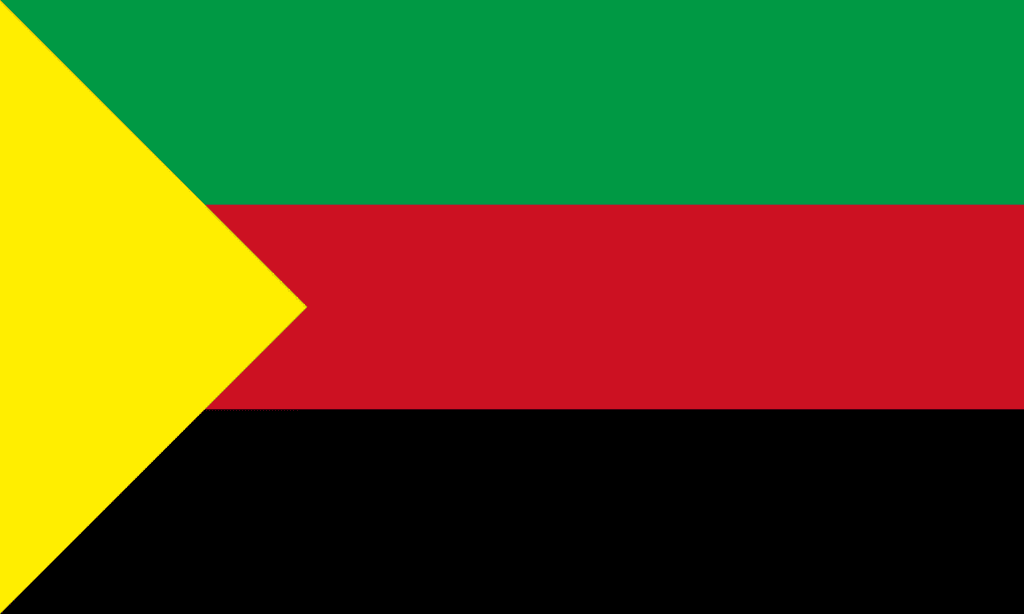
The flag of the MNLA, and the proposed national flag of the State of Azawad. Azawad is the Tuareg name for the Tuareg homeland.
At the same time, fighters from the Al-Qaida in the Islamic Maghreb (AQIM) in Algeria were infiltrating Mali from the north, and would band together with local Islamist activists in Mali from the group “Defenders of the Faith” or Ansar Dine.[3] Ansar Dine had been active from before the Tuareg revolt in 2012, but the fall of the Malian army in the north Mali region allowed them to rise to prominence.
The Malian army had struggled during the 2007-2009 revolt, which ended in a ceasefire. The army was mainly based in the south, where it also recruited its forces. Tuareg fighters were supposed to be integrated into the Malian army after a previous ceasefire agreement, but this hadn’t been done, leaving the army almost without locals in their ranks in their defense of the northern cities.
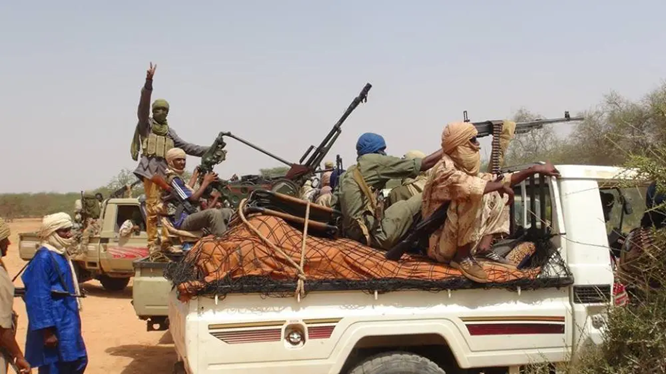
MNLA fighters in 2012. The use of armed pickup trucks for mobility and combat is common in the Sahel region.
The MNLA recruited thousands of fighters, and in January of 2012 they began an armed revolt in the far north of Mali, which saw rapid success. The MNLA and Ansar Dine forces advanced in tandem, taking land in an uneasy alliance. The capture of smaller towns and the countryside happened with little violence, and the limited Malian forces available mostly withdrew as the rebels advanced.
Lower level officers in the Malian army carried out a coup in March of 2012, angry at the government’s failure to contain the revolt. They promised to contain the rebellion, and a transition back to civilian rule once this was done. The goal of containing the rebellion turned out to be easier said than done, and the coup destabilized the country enough to make the army’s collapse in the north accelerate. Right after the coup, the MNLA took over all three provincial capital in the north, and would, on April 6th, 2012, declare the independence of the State of Azawad.[4]
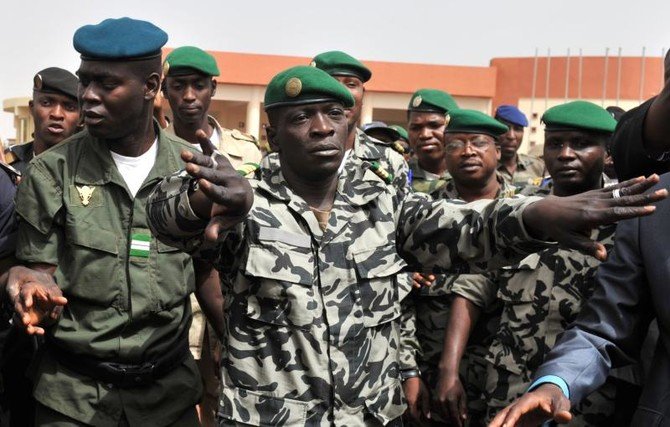
Captain Amadou Sanogo (middle) took charge of Mali during the junta rule period of 2012-2013.
The creation of Azawad marked the fullfilment of the goals of the MNLA. Their new state contained all three of north Mali’s regions and half of the Mopti region. The state would create a nation state for Mali’s Tuareg population of around a million, though it would also include just as many of the settled Songhai people, who were not immediately positive to this new country.
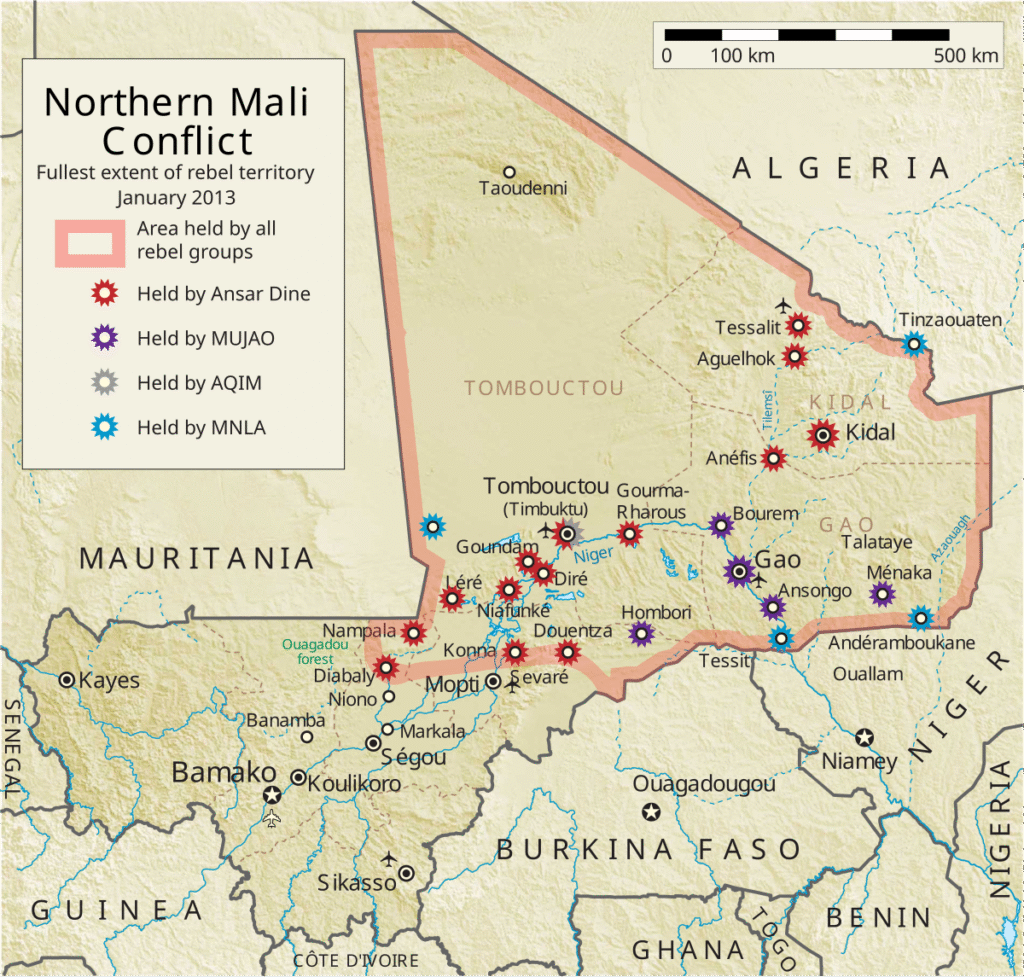
The combined area controlled by all rebel groups on the eve of the French intervention.
As much as this may have seemed like a complete victory for the Tuaregs, it was not to last. The uneasy alliance with the Ansar Dine soon proved to be a liability, as they competed over control over recruitment and cities that they had taken together. In June, fighting broke out, and Ansar Dine with their jihadist allies took control over all three provincial capitals in the north, effectively ending the independence of Azawad after only two months. The state of Azawad was officially laid to rest when, in talks with the Malian government, the leadership of Azawad again recognized Mali as a united state.[5]
Sources:
[1] https://www.bbc.com/news/world-12647115
[2] https://jamestown.org/program/a-portable-war-libyas-internal-conflict-shifts-to-mali/
[3] https://www.brookings.edu/articles/the-new-al-qaeda-menace/
[4] https://reliefweb.int/report/mali/timeline-northern-conflict
[5] https://www.aljazeera.com/news/2012/12/5/mali-rebels-agree-to-respect-national-unity
The World enters the war, 2013
Where the international community had been content with viewing the Tuareg revolt as an internal affair, the jihadist takeover of northern Mali prompted action. There are multiple reasons for this. The first is that unlike the MNLA, Ansar Dine’s goals for Mali weren’t restricted to the north, rather they sought to take over the entire country. The second is the brutality that Ansar Dine’s control entailed, both in their violence against civilians and in their destruction of Timbuktu’s cultural legacy. The third reason was that the war against terrorism was still fairly popular worldwide, and the international community was not about to allow Al Qaida a victory after the death of Bin Laden.
The support for Mali came in the form of three operations, led by the African Union and ECOWAS, the European Union, and France.
The first was an African support mission (AFISMA), authorized by the UN in December 2012. It was organized by the African Union and ECOWAS, and served to stabilize the front, where the Malian army had been deteriorating. The main contributing countries were Nigeria, which led the ECOWAS contingent of the operation, and Chad, which provided the largest single contingent.[1] Nigeria arrived first, with 900 soldiers by January of 2013,[2] but Chad would by February have 1800 soldiers in Mali.[3] The Chadian intervention was at first part of the French, not African operation, but when they joined AFISMA they became a leading country.[4]
Logo of ECOWAS, the west African trading bloc. The organization has taken a leading role in multiple military interventions, including AFISMA in Mali. Niger, Mali and Burkina Faso used to be members before their military coups.
In April 2013, AFISMA was turned into the UN mission MINUSMA, where Chad remained the largest contributor, followed by Bangladesh.[5] Nigeria withdrew their forces to focus on their own security after being snubbed from MINUSMA leadership.[6] Resolution 2100, which made AFISMA into MINUSMA, is a special case among peacekeeping mandates in two ways. For one, it’s a particularly one-sided resolution, providing only for supporting the Malian government and condemning rebel groups. The other aspect is that it’s a particularly ambitious mandate, allowing the peacekeepers to support the Malian army in reestablishing control over the country. These two decisions gave MINUSMA an implicitly offensive mandate, and made it the deadliest UN peacekeeping operation to date.
Aside from AFISMA/MINUSMA, Mali also founded the G5 Sahel together with Mauritania, Burkina Faso, Niger and Chad. These five states were all united in a common concern for the jihadist threat, and would seek to cooperate across the same borders that jihadist groups tend not to respect. All five states are traditionally friendly to France, and would all cooperate with both the French and the European missions.
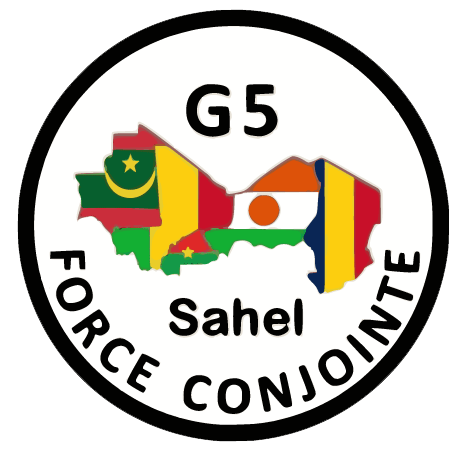
The logo of the G5 Sahel joint task force, an interstate military unit for the five formerly French colonies in the Sahel, represented by a flag map of the five countries.
The second operation, and the smallest of the three, was the European Union Training Mission (EUTM), which saw soldiers from 26 European countries deployed in Mali to assist in training and restoring the damaged Malian army. The EUTM was a pure support mission, and would be involved with around 1000 personnel.[7] The EUTM was led by France in the beginning, but command was later cycled between other EU countries.
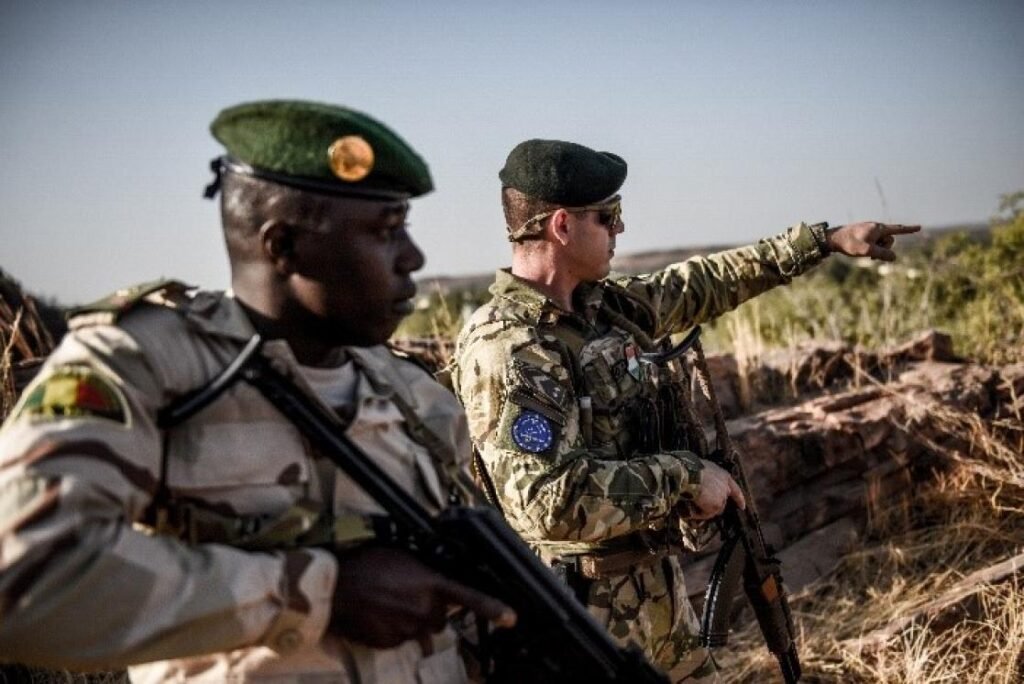
A soldier from the EU training mission with a Malian colleague.
The Malian army numbered 7350 soldiers in 1998 (latest estimate I found from before the war).[8] Of these, hundreds had been killed in battle or executed, hundreds had been captured, hundreds defected and more than a thousand soldiers had fled to neighboring countries.[9] It was a disaster for the Malian army, and it needed to be rebuilt and strengthened to avoid a new collapse. It is hard to say how far the EUTM got in this goal, but the Malian army today is holding up better than it did in 2012.
The third and most important operation was the French Operation Serval. While AFISMA would eventually grow into a larger operation, the French deployment of 4000 troops from January 11th, 2013, was the most important force in stopping the Ansar Dine advance and beginning the counterattack. French forces acted as a spearhead that was impossible for Ansar Dine to stop.
The French military used transport planes to minimize the difficulties of northern Mali’s geographic scope and elite armored units and attack helicopters to defeat every stronghold and city held by Ansar Dine. By the end of January 2013, the French had given all three provincial capitals in northern Mali back to the Malian army, forced Ansar Dine on the run into the desert and allowed the MNLA, now allied with the Malian government against the jihadists, to take back much of the countryside.[10]
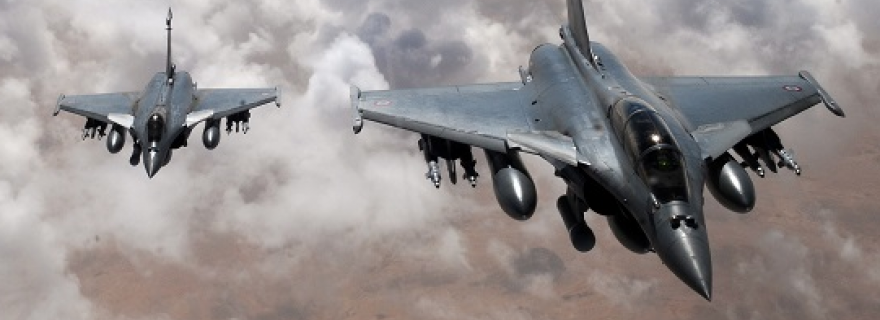
Two French Rafale fighter jets above Mali.
As much as this may have seemed like a complete victory for the French, it was not to last. The MNLA and Mali were unwilling to fully reconcile, and the Malian army controlled nothing apart from the cities in the north. The return to democracy from military rule was marked by deadly internal violence in the military, as the coup leaders wanted to ensure that they would not suffer consequences for their actions.[11] The worst of it was that Ansar Dine, while damaged, was able to escape into the mountainous northeast of Mali, where they began to recover their strength and continue the fight.
Sources:
[1] https://studies.aljazeera.net/en/reports/2013/02/20132148940690455.html
[2] https://www.aljazeera.com/news/2013/1/18/mali-army-retakes-key-towns-from-rebels
[3] https://www.bbc.com/news/world-africa-21555898
[4] https://adf-magazine.com/2014/09/into-the-terror-sanctuary/
[5] https://peacekeeping.un.org/en/mission/minusma
[6] https://issafrica.org/iss-today/nigeria-pulls-out-of-minusma-protest-or-prioritisation-of-domestic-security
[7] https://www.eeas.europa.eu/eutm-mali/eutm-mali-european-union-training-mission-mali-military-mission_und_en
[8] https://wri-irg.org/en/programmes/world_survey/country_report/en/Mali
[9] https://www.nytimes.com/2013/01/25/world/africa/mali-army-riding-us-hopes-is-proving-no-match-for-militants.html
[10] https://www.leidensecurityandglobalaffairs.nl/articles/operation-serval-the-french-intervention-in-mali
[11] https://www.bbc.com/news/world-africa-17906621
The war stalls and spreads, 2014-2019
As the international involvement in Mali stretched into its second year, it became clearer and clearer that the war would not reach a quick and easy solution, and all three international operations were extended past the originally granted mandates. The French Operation Serval was transformed into Operation Barkhane, shifting the French focus from offensive action to stabilization.
The international forces had no goal of fighting the MNLA, but the Malian government kept fighting against and struggling against the Tuareg rebels throughout 2014. With the jihadist threat at least temporarily subdued, the Malian focus turned towards uniting the country. The pro-government militia alliance Plateforme, made up mostly of Songhai or Tuareg people who had some grievances with the MNLA, stood for much of the fighting in the north through 2014 and 2015.
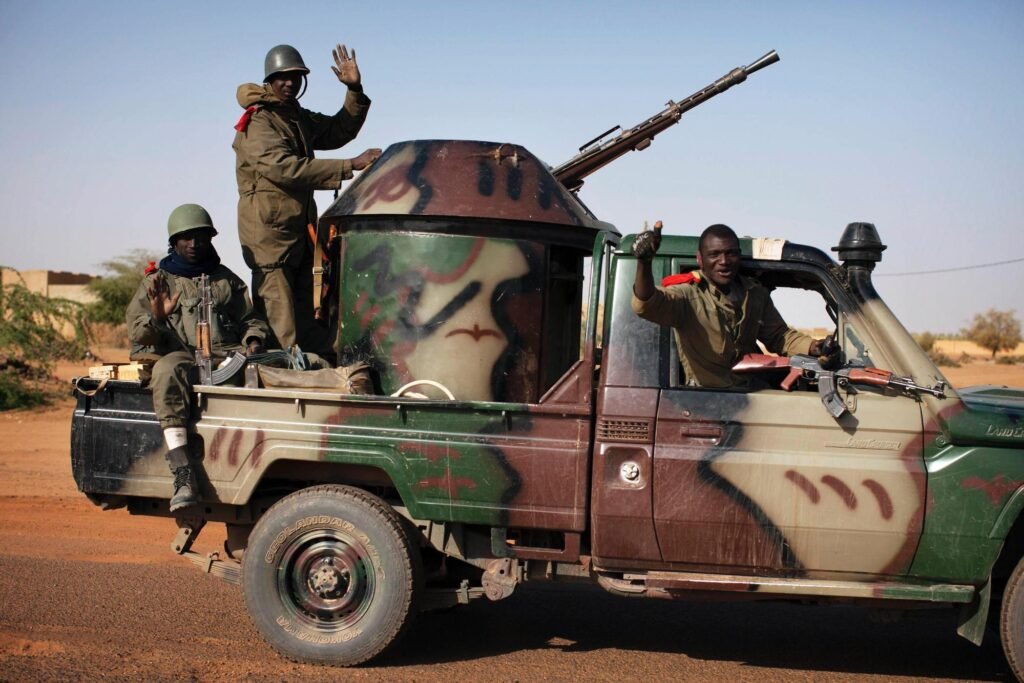
Malian army soldiers on a pickup truck modified to look like a professional fighting vehicle.
Unable to beat the MNLA and seeing the slow resurgence of Ansar Dine, the Malian government sought a political solution to the conflict. In 2015, the Algiers accords officially ended hostilities between the MNLA and the Malian government, and laid the ground work for cooperation against the jihadists. This agreement that would last as long as Mali’s democratic governance.
Ansar Dine and their Al-Qaida associates began carrying out a slow spillover into Mali’s neighboring countries Niger and Burkina Faso, where the international support was not as entrenched. Both Niger and Burkina Faso began struggling against the new jihadist movements in their borders. The spread of the war into two more countries spread out the international efforts, prevented Niger and Burkina Faso from supporting Mali, and provided the jihadists with a wider base of recruitment. There’s no real start date for the jihadist insurgencies in Niger and Burkina Faso, but it kept getting worse throughout the 2010s.
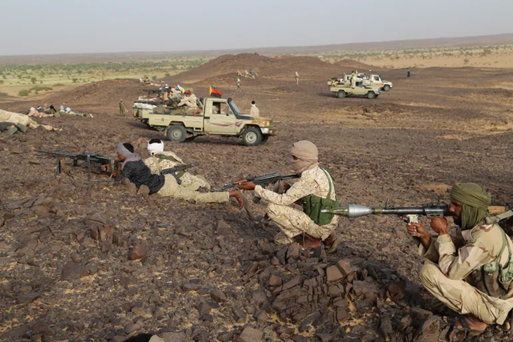
MNLA fighters on the outskirts of Kidal in 2016. The MNLA had a ceasefire with the government at this time, but fought over multiple sites like Kidal against pro-government militias.
Niger was struck from both sides by the jihadist threat, as Boko Haram and the Islamic State West Africa Province (ISWAP) began infiltrating Niger from Nigeria to the south in the mid-2010s. Boko Haram’s defeats in Nigeria in 2015 pushed the group to migrate north, making it Niger’s problem. Throughout the late 2010s, ISWAP managed to spread through Niger and spill over into Burkina Faso and Mali.
ISWAP and the Al-Qaida aligned groups, while both jihadist, are staunchly ideologically opposed, and have fought each other on many occasions in the Sahel. All Al-Qaida aligned groups would in 2017 unite and form a new group, the “Support group for Islam and Muslims” usually known by its Arabic acronym, JNIM.[1] At around the same time as Al-Qaida was consolidating in the region, Boko Haram and ISWAP had a violent falling out, which would in 2021 culminate with ISWAP killing Boko Haram’s leader and effectively knocking them out of Niger.[2]
Sources:
[1] https://issafrica.org/iss-today/malis-jihadist-merger-desperate-or-dangerous
[2] https://www.csis.org/analysis/boko-harams-leader-dead-what-are-humanitarian-and-security-implications
Coups, withdrawals and new actors, 2020-2025
Throughout the 2020s the security situation has continued to consistently deteriorate. This development has been coupled with the overthrow of every democratic regime in the Sahel except for Mauritania’s, the complete withdrawal of French, EU and UN forces from the Sahel, the entry of Russian and Turkish forces into the conflict and the renewal of conflict between the Malian government and Tuareg rebels.
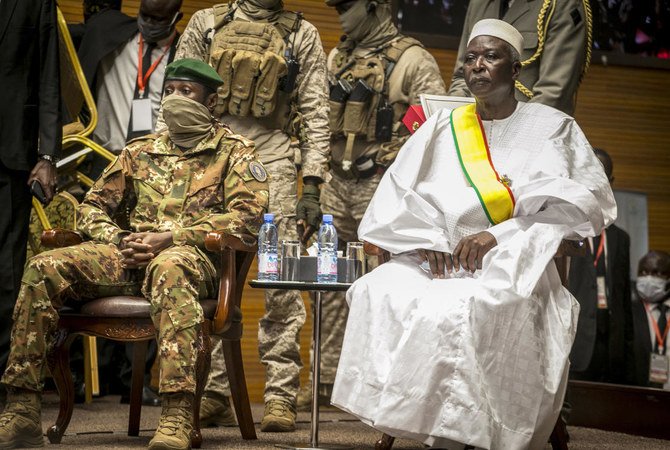
Bah N’Daw (right), a former army colonel, was made interim president by colonel Assimi Goïta (left) by means of military coup in 2020.
In 2020, Mali experienced a popular coup, where the military backed protesters against the president and forced him to resign.[1] A new president, Bah N’Daw, was appointed, and made responsible for the return to civilian rule. Much like in 2012, he did the proper preparations for the return to civilian rule. This time, however, the preparations were interrupted by another coup led by the rest of the military transitional council.[2] This second coup government of Mali is still in power at the time of writing.
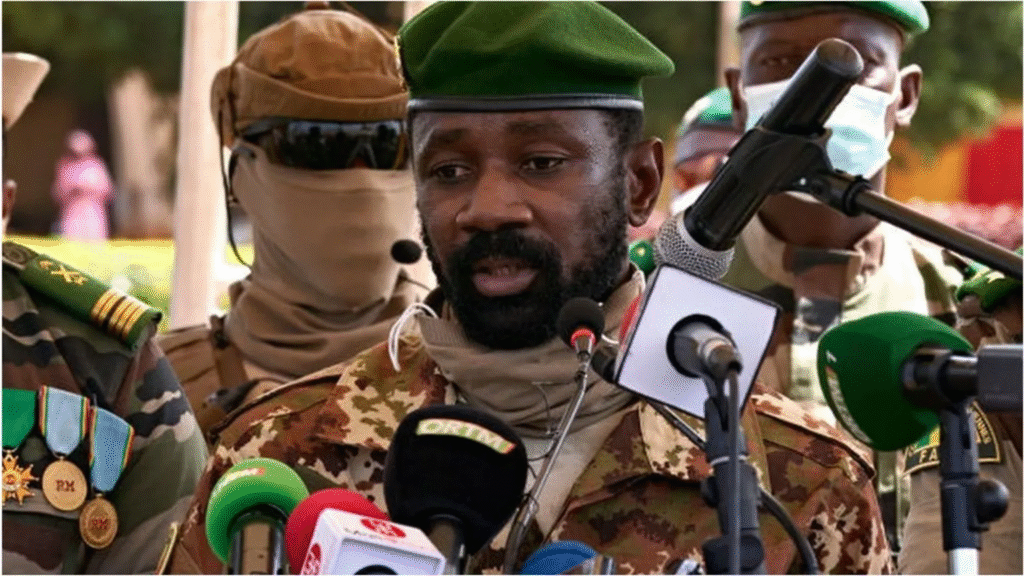
Assimi Goïta (middle) was made president by Assimi Goïta (middle) by means of military coup in 2021.
The sitting Sahelian presidents, at least outside of Chad, were legitimately elected, but they were plagued with corruption and a worsening security situation. In every Sahelian coup since at least 2012, the failure of the sitting government to combat the jihadists has been a key part of the coup leaders’ rhetoric. Mauritania has not had a coup, but has also been spared from the worst of the fighting. Chad was already led by a de-facto military dictatorship, and when the general president was killed on the frontline in 2021 his son took power.
The military government leaders tend to claim to have faith that they are the only people capable of stopping the worsening insurgencies, with their intimate knowledge of warfare and sheer force of will. So far there hasn’t been a military government that has performed better than an overthrown elected one in the Sahelian war, but perhaps one day with enough coups one will emerge.
Following the coup in Mali, the French forces in the country began a partial withdrawal at the orders of French president Macron.[3] This first military withdrawal by France was not initially wanted by the Malian government, which sought the help of Wagner to make up for the loss of French support. As relations kept souring, the Malian government would in turn demand that the remaining French forces left in 2022.[4] In response, the EUTM also suspended operations, leaving only the UN forces in Mali.[5] Mali would request the withdrawal of the UN forces in 2023.
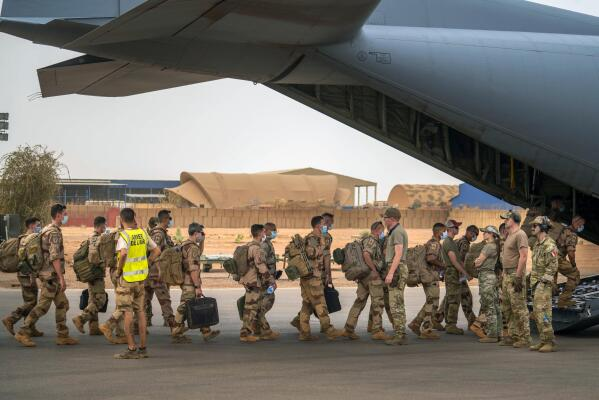
French forces board a transport plane to leave Gao, 2022.
The withdrawal of the UN had the impact of renewing hostilities between the Malian government and the Tuareg rebels, who had been at peace since 2015. The Tuareg rebels took control of UN bases as the UN was withdrawing, which led to clashes with the Malian army at multiple points in the north of Mali.[6] The renewed fighting went poorly for the Tuareg rebels, and by October 2023 the Malian army had captured Kidal, the only one of Northern Mali’s three provincial capitals that the Tuaregs still controlled.[7]
The renewed fighting with the Tuaregs, the international isolation and the loss of Mali’s cooperation with its allies in the G5 Sahel caused problems for Mali, but this was partially helped by the military coup in Burkina Faso in 2022 and in Niger in 2023. The three of them formed the Alliance of Sahel States (AES) which renewed their security cooperation and left the G5 Sahel with only two members not sharing a border.[8]
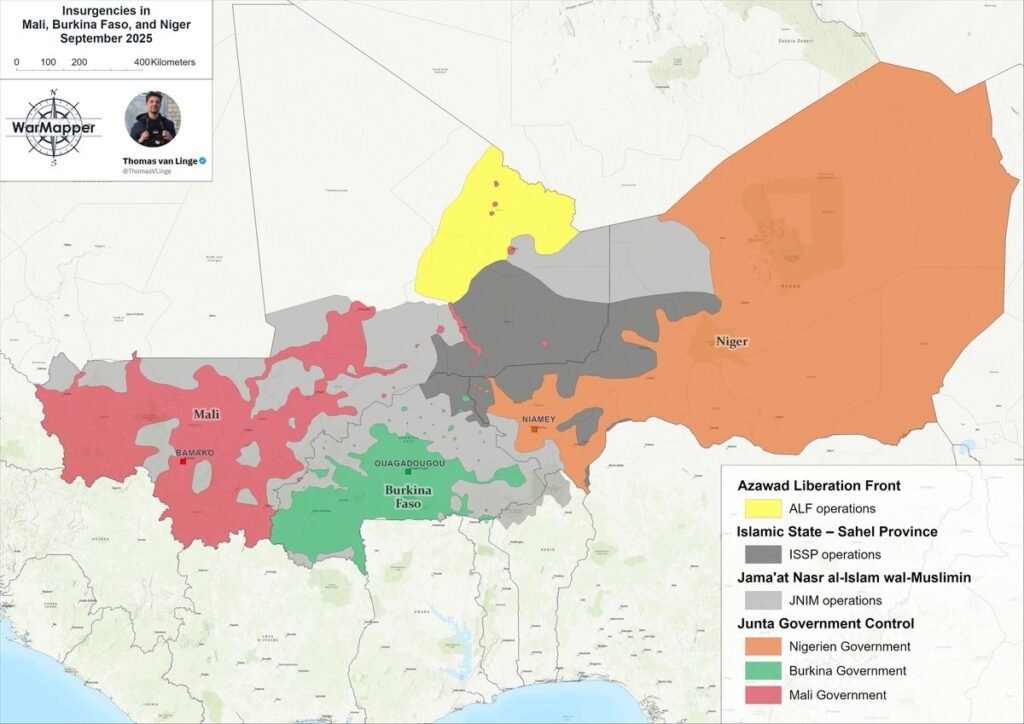
Freelance reporter Thomas Van Linge’s map of the Sahel war as of September 2025.
While the government in Mali has been fighting both jihadists and secular Tuareg rebels, Niger and Burkina Faso have been facing off against only jihadists. In Niger, the insurgency is relatively contained, but it’s also contained in some of Niger’s most densely populated districts, not far from the capital Niamey. In 2022, Burkina Faso’s government controlled only around 60% of its own country, and has been losing ground since.[9]
The two international powers supporting the AES are Turkey and Russia. The Russian involvement is older, as Wagner has been in Mali since 2021. More recently, as of this June, Wagner has withdrawn entirely and been replaced by the Russian Africa Corps, placing Russian forces in the Sahel directly under the control of the Russian ministry of defense.[10]
The size of the Russian Africa Corps is something of an unknown, but estimated at 1,800 troops in 2024.[11] This force is far smaller than the French force was, and is in fact more comparable to the size of the EUTM. Considering that Russia has multiple times failed to guarantee armed support to its allies since the start of the Ukraine war, it is probable that the Russian military footprint will remain around the size it is now.
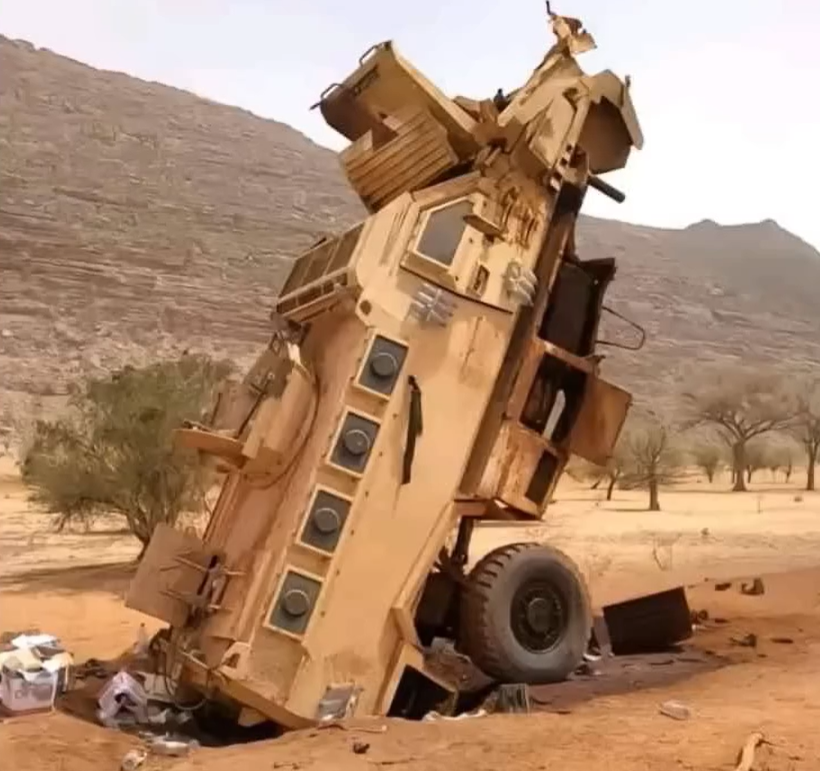
A Russian armored car after the battle of Tinzaouaten in 2024, where a Malian army convoy with a Wagner escort was ambushed and wiped out by rebels.
The Turkish involvement is different, deploying Syrian mercenaries and selling drones rather than deploying Turkish soldiers directly. Around 1,100 soldiers from the Turkish-backed Syrian forces have been transported to the Sahel, chiefly Niger.[12] This operation is carried out by Sadat, Turkey’s only Private Military Company. The sale of drones to the Sahelian governments is something Turkey is more open about, and the drones provided by Turkey are the only real air power the AES has available.[13]
The jihadist insurgency is spreading beyond just the Sahel region. Fighters from JNIM have infiltrated into the northern regions of the entire West African coastal region to the south of the Sahel. Attacks against border guards, military bases and civilians have been carried out by JNIM and associated groups in the Ivory Coast, Ghana, Benin and Togo, while the remnants of Boko Haram remain active in Nigeria.[14] JNIM still lacks a stable foothold in the coastal countries, meaning their presence there is limited to single strikes carried out by infiltrators, but that may change. All the coastal countries by the coast of Guinea have major Muslim minority populations in the northern regions, and if JNIM manages to begin recruitment there the war will spread.
Sources:
[1] https://www.bbc.com/news/world-africa-53868236
[2] https://www.crisisgroup.org/africa/mali/mali-coup-within-coup
[3] https://www.france24.com/en/africa/20211116-french-forces-pull-out-of-tessalit-base-amid-northern-mali-drawdown
[4] https://www.voanews.com/a/mali-demands-french-european-troops-leave-country-immediately/6448383.html
[5] https://www.reuters.com/world/africa/eu-close-mali-military-training-mission-2024-05-08/
[6] https://www.africanews.com/2023/10/05/mali-rebels-claim-capture-of-new-army-camp//
[7] https://www.reuters.com/world/africa/malis-army-claims-capture-rebel-stronghold-kidal-2023-11-14/
[8] https://www.reuters.com/world/africa/mali-niger-burkina-faso-sign-sahel-security-pact-2023-09-16/
[9] https://www.aljazeera.com/news/2022/6/18/state-controls-only-60-percent-of-burkina-faso-mediator
[10] https://www.aljazeera.com/news/2025/6/16/wagner-vs-africa-corps-the-future-of-russian-paramilitaries-in-mali
[11] https://ctc.westpoint.edu/africa-corps-has-russia-hit-a-ceiling-in-africa/
[12] https://adf-magazine.com/2024/07/turkish-pmc-sadat-competes-for-sahel-influence/
[13] https://www.trtafrika.com/article/18237478
[14] https://reliefweb.int/report/burkina-faso/acled-regional-overview-africa-may-2025
https://www.kas.de/documents/261825/16928652/The+jihadist+threat+in+northern+Ghana+and+Togo.pdf
https://www.state.gov/reports/country-reports-on-terrorism-2021/cote-divoire
The future of the Sahel
The war in the Sahel is in all likelihood not going to end anytime soon. The military governments are struggling to root out jihadist insurgents in the countryside, and the jihadist insurgents are struggling to gather the strength to capture cities in focused assaults. The international support of Russia and Turkey is much less than that of France was, and the French intervention did not work.
In the long run, the war will have to end one way or the other, but that won’t be before the strategic situation changes significantly. In the medium term, two options for the war to settle into are most likely. One is that the Sahel states consolidate, and the insurgents wage a stubborn and reduced guerilla war from isolated regions, as they did in the late 2010s. The second is that the insurgents keep winning, but fail to capture national capitals and the most valuable regions, leaving the national government with only a rump state to rule in.
This is not to say that the war in any one of the countries can’t end sooner. The Afghan National Government simply folded against the pressure of the Taliban in 2021, despite the Taliban not really having the heavy weaponry to take key cities. Afghanistan is also the only example of a modern state falling to an Islamist insurgency, so it’s unlikely that a similar situation will arise in the Sahel.
A wide and ideologically driven movement like JNIM or the Taliban suddenly collapsing after years of fighting is also very rare. Even in moments where a complete collapse appears to have happened, as with Ansar Dine in Mali in 2013, the decentralized nature of the organization can allow it to survive heavy losses, to then regroup and recover.
The continued warfare in the northern Saharan provinces is bad news for the Malian army, and the insistence on fighting Tuareg rebels and holding on to northern cities could turn out to be a major blunder. The supply lines are long, and news of Malian army soldiers falling victim to ambushes are common. The army is not strong enough to focus on every front, and the northern focus they’ve had since 2023 has allowed major jihadist gains in the south. Malian military leadership appears convinced that they will be able to defeat both enemies they face, Tuareg rebels and jihadist insurgents, at the same time. They are not, however, proving that they are capable of winning that fight.
The war spreading south of the Sahel could go either way for its result in the Sahel. One possibility is that a jihadist insurgency in the coastal countries will effectively surround the Sahel states and give JNIM more power that it can use to threaten the Sahel, which would make an ultimate defeat of the Sahel states more likely. All three main Sahel states are landlocked and reliant on overland trade for survival, and a full blockade would have them rely on air transport and internal production, which none of them can afford. The other option is that the war spreading south will cause a wider regional investment from the coastal states to defeat the insurgency, though with the Sahel states leaving ECOWAS there is little political interest in doing such cooperation today.
The war in the Sahel is not an optimistic story. There are no truly good actors in the war, and the worst of the sides is the one that currently has the initiative. The jihadist factions are unlikely to enter talks and will be tough to root out, the coup governments don’t appear to have any plans for a transition to civilian rule anytime soon, and the Tuareg rebels in the north of Mali are neither close to giving up or to achieving their dream of the state of Azawad.
While the fate of countries is decided on the battlefield, the fate of people doesn’t need to be. The UN’s World Food Programme https://www.wfp.org/countries/mali and doctors without borders https://www.doctorswithoutborders.org/what-we-do/where-we-work/mali make a very tangible impact on people’s lives, if you, the reader, are able to spare the money for a donation. No one can be forced to care or to contribute, but it doesn’t take much to do so.
Leave a Reply